Books
What is Ecofeminism?

What is Ecofeminism? (Polity Press, forthcoming February 2027) is a concise introduction to ecofeminism that explains its key concepts, historical development, and the tools it offers for addressing global environmental challenges. Johanna Oksala and Sanna Karhu demonstrate that critical and practical approaches to living with environmental catastrophe must be grounded in an understanding of the gendered dimensions of the crisis. They argue that a radical re-evaluation and recuperation of ecofeminism is vital today, drawing on its enrichment by queer theory, critical race theory, decolonial feminism, climate justice, intersectional feminism, and critical animal studies. Correcting simplifications and misrepresentations, Oksala and Karhu critically reassess ecofeminist thought, placing its future and potential at the center of their inquiry.
Feminism, Capitalism, and Ecology
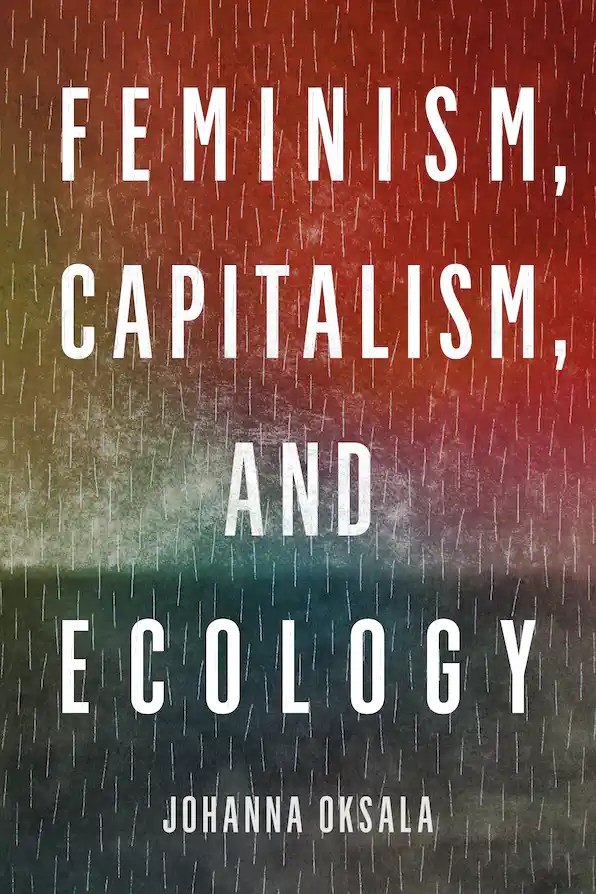
Feminism, Capitalism, and Ecology (Northwestern University Press, 2023) develops a new way of bringing feminist and ecological responses to capitalism together into a cohesive framework. By exposing the systemic logic by which environmental destruction and gender oppression are jointly rooted in capitalism, it establishes the theoretical foundations for an effective political alliance. The traditions of materialist ecofeminism and Marxist feminism are critical starting points. But the rapid rise of biotechnology and the steady increase of precarity necessitate a model of resistance that responds to the distinctive challenges of contemporary biocapitalism.
Reviews
- Review of Feminism, Capitalism, and Ecology by Annie Sandrussi. Environmental Philosophy 22, no. 2 (2025): 348–352. DOI: 10.5840/envirophil2025222161.
- Review of Feminism, Capitalism, and Ecology by Jennie C. Stephens. Signs, 2024.
- Review of Feminism, Capitalism, and Ecology by Aleksi Paavilainen. Sukupuolentutkimus, 2024.
Feminist Experiences: Foucauldian and Phenomenological Investigations
Feminist Experiences: Foucauldian and Phenomenological Investigations (Northwestern Universtity Press, 2016) develops and defends a distinctive understanding of feminist philosophy as social critique. Feminist philosophy is essentially a political endeavour aiming to expose, analyze, and ultimately change gendered power relations. However, such an understanding of feminist philosophy raises a host of theoretical problems and paradoxes. The book investigates the philosophical challenges and outlines the ontological presuppositions and methodological innovations the project requires. Drawing on conceptual tools from the thought of Michel Foucault, but also from the tradition of phenomenology, it explores the role of experience in feminist philosophy and its relationship to language and linguistic meaning. It concludes by sketching a feminist ontology of the present through a critical investigation of neoliberalism and the challenges it presents to feminist theory and politics. The book has been reviewed in professional journals and discussed in book panels at NoSP 2017 in Trondheim, Norway, and at SPEP 2017 in Memphis, Tennessee.
Reviews
- Review of Feminist Experiences by Tina Sikka. Phenomenological Reviews, 2016.
- Review of Feminist Experiences by Ladelle McWhorter. Notre Dame Philosophical Reviews, 2016.
- Review of Feminist Experiences by Carolyn Culbertson. Human Studies, vol. 40, no. 1, 2017.
- Feminism as critique: comments on Johanna Oksala’s Feminist Experiences by Amy Allen. Continental Philosophy Review, vol. 52, no. 1, 115-123, 2018.
- Feminism as critique: comments on Johanna Oksala’s Feminist Experiences by Andreea Smaranda Aldea. Continental Philosophy Review, vol. 52, no. 1, 125-134, 2018.
- Review of Feminist Experiences by Jana Sawicki. European Journal of Philosophy, vol. 25, no. 4, 1236-1239, 2018.
Foucault, Politics, and Violence
 Foucault, Politics, and Violence (Northwestern University Press, 2012) develops an original philosophical position by outlining a distinctive conception of the political and its relationship to violence. It allows us to understand forms of violence that characterize our current political landscape: the relationship between violence and the law in the post-2001 world, gendered violence, state violence and its relationship to neoliberalism, and the significance of terrorism for our contemporary understanding of politics. In addition to Foucault’s thought, the book assesses critically the work of several other prominent philosophers advocating an agonistic conception of politics such as Carl Schmitt, Hannah Arendt, Chantal Mouffe, Giorgio Agamben and Slavoj Žižek. The book has been reviewed in professional journals and discussed in a book panel at SPEP 2013 in Eugene, Oregon.
Reviews
- Review of Foucault, Politics, and Violence by Chloë Taylor. Notre Dame Philosophical Review, 2014.
- Review of Foucault, Politics, and Violence by Christopher Mayes. Foucault Studies, no. 17, 232-236, 2014.
- Comments on Foucault, Politics, and Violence by Kevin Thompson. Philosophy Today, vol. 58, no. 2, 279-288, 2014.
- Comments on Foucault, Politics, and Violence by Jana Sawicki. Philosophy Today, vol. 58, no. 2, 289-295, 2014.
- Review of Foucault, Politics and Violence by Jana Sawicki. Philosophia, vol. 5, no. 1, 2015.
Foucault on Freedom
 Foucault on Freedom (Cambridge: Cambridge University Press, 2005) identifies the different interpretations of freedom in Foucault’s philosophy and shows that in order to appreciate his project fully we must understand his complex relationship to phenomenology. The book also discusses Foucault’s treatment of the body in relation to the feminist work on the topic and makes new openings in feminist phenomenology. The book has been reviewed in professional journals, discussed in book panels (SPEP 2006, British Society for Phenomenology 2010), and cited widely.
Reviews
- Review of Foucault on Freedom by Ladelle McWhorter. Notre Dame Philosophical Reviews, 2005.
- Review of Foucault on Freedom by Michael Shapiro. Redescriptions. Yearbook of Political Thought and Conceptual History, vol. 10, no. 1, 194-195, 2006.
- Review of Foucault on Freedom by Chris Blakley. The Journal of Value Inquiry, no. 41, 131-134, 2007.
- Review of Foucault on Freedom by Christina Hendricks. The Journal of Speculative Philosophy, vol. 22, no. 4, 2008.
- Review of Foucault on Freedom by Corey McCall. Foucault Studies, no. 5, 136-141, 2008.
- Review of Foucault on Freedom by Peter Trnka. Philosophy in Review, vol. 27, no. 3, 211-213, 2007.
Political Philosophy: All That Matters
Political Philosophy: All That Matters (London: Hodder and Stoughton, 2013) is a compact guide to the key issues of political philosophy. Rather than attempting to provide definite answers, the book invites readers to recognize many of the issues encountered in everyday life as political, the outcome of human practices that incorporate power relations, social norms and obligations. The key claim is that political philosophy should be understood as an open-ended, critical project that concerns everyone. The book employs an original structure: each chapter focuses on selected classic texts in political philosophy, which are briefly introduced and analysed. The texts then function as a springboard for a discussion of central contemporary issues in political philosophy.
How to Read Foucault

How to Read Foucault (London: Granta Books, 2007) is an accessible introduction to Foucault’s thought written for a wide academic audience. Through close readings of selected passages from his books, essays, lectures, and interviews, it introduces his central philosophical concerns and the conceptual tools he developed for critically examining the present. The book emphasizes how Foucault challenges the apparent inevitability of our practices, institutions, and ways of understanding ourselves by revealing their historical contingency. A US edition was published by W. W. Norton in 2008, and translations have been published in South Korea, Japan, Brazil, China, and Turkey.
Reviews and Recommendations
- Review of How to Read Foucault by Trent H. Hamann. Foucault Studies, no. 8, 163–165, 2010.
- Selected as one of the five best books on Foucault by Gary Gutting. Five Books, 2017.
Edited Books and Journal Special Editions
- Daphne Pons, Andrew Krema, and Johanna Oksala (eds.). Puncta: Journal of Critical Phenomenology, vol. 6, no. 2, Special Issue: Phenomenology and Critique. 2024.
- Johanna Oksala and Laura Werner (eds.), Feministinen filosofia (Feminist Philosophy). Helsinki: Gaudeamus. 2005.
- Sara Heinämaa and Johanna Oksala (eds.), Rakkaudesta toiseen: kirjoituksia vuosituhannen vaihteen etiikasta (Essays on Ethics). Helsinki: Gaudeamus. 2001.

Refereed Journal Articles
- Rethinking the Political at the End of the World. Canadian Journal of Philosophy, forthcoming.
- Foucault’s Revision of Ideology Critique. Foucault Studies vol. 38, 1–23. 2025. https://muse.jhu.edu/article/974017.
- Foucault, Maquiavel e a arte de governar (Foucault, Machiavelli, and the Art of Governing), trans. from English by Malcom Guimarães Rodrigues. Revista Ideação, vol. 1, no. 51, Michel Foucault, 40 anos depois, 82–92. 2025.
- The Existential Threat of Climate Change: From Climate Anxiety to Post-Nihilist Politics. Environmental Philosophy, vol. 20, no. 2, 191–214. 2023.
- Neoliberal Subjectivation: Between Foucault and Marx. Critical Inquiry, vol. 49, no. 4, 581-604. 2023.
- The Method of Critical Phenomenology: Simone de Beauvoir as a Phenomenologist. European Journal of Philosophy, vol. 31, no. 1, 137–150. 2023.
- Beyond Neoliberal Realism: Foucault’s Late Politics. Foucault’s Late Politics, a special issue of South Atlantic Quarterly, vol. 121, no. 4, 655–673. 2022.
- Feminism against Biocapitalism: Gestational Surrogacy and the Limits of the Labor Paradigm. Signs: Journal of Women in Culture and Society, vol. 44, no. 4, 883–904. 2019.
- Feminism, Capitalism, and Ecology. Hypatia: A Journal of Feminist Philosophy, vol. 33, no. 2, 216 – 234. 2018.
Translated into Portuguese and published in Brazil in 2020. Reprinted in Climate Crisis as a Challenge for the Humanities: A Reader, edited by Karin Esders, 89–110. Berlin: De Gruyter. - Affective Labor and Feminist Politics. Signs: Journal of Women in Culture and Society, vol. 41, no. 2, 281–303. 2016.
- Foucault, Husserl and the Philosophical Roots of German Neoliberalism. Continental Philosophy Review, vol. 49, no. 1, 115–126. 2016.
- Political Philosophy in the Era of Climate Change: Between Eco-Cosmopolitanism and the Green State. Graduate Faculty Philosophy Journal, vol. 37, no. 1, 51–70. 2016.
- In Defense of Experience. Hypatia: A Journal of Feminist Philosophy, vol. 29, no. 2, 388–403. 2014.
- What Is Political Philosophy? Materiali Foucaultiani, vol. III, nos. 5–6, 91–112. 2014.
- Foucault, Feminism and Neoliberal Governmentality. Foucault Studies, a special issue on feminist theory, no. 16, 32–53. 2013.
Translated into Spanish and published in Para una crítica del neoliberalismo: Foucault y Nacimiento de la biopolítica, edited by Rodrigo Castro and Emmanuel Chamorro, 257-294. Madrid: Lengua de Trapo (2020). - Sexual Experience: Foucault, Phenomenology and Feminist Theory. Hypatia: A Journal of Feminist Philosophy, vol. 26, no. 1, 207–223. 2011.
- The Neoliberal Subject of Feminism. Journal of the British Society for Phenomenology, vol. 42, no.1, 104–120. 2011.
- Violence and Neoliberal Governmentality. Constellations: An International Journal of Critical and Democratic Theory, vol. 18, no. 3, 474–486. 2011.
- How Is Feminist Metaphysics Possible? A Foucauldian Intervention. Feminist Theory, vol. 12, no. 3, 281–296. 2011.
- Foucault’s Politicization of Ontology. Continental Philosophy Review, vol. 43, no. 4, 445–466. 2010.
- Violence and the Biopolitics of Modernity. Foucault Studies 10, 23–43. 2010.
- The Management of State Violence: Foucault’s Rethinking of Political Power as Governmentality. Graduate Faculty Philosophy Journal, vol. 28, no. 2, 53–66. 2007.
- A Phenomenology of Gender. Continental Philosophy Review, vol. 39, no. 3, 229–44. 2006.
Translated into German and published in Dem Erleben auf der Spur: Feminismus und Phänomenologie, edited by Hilge Landweer and Isabella Marcinski, 219-234. Bielefeld: transcript (2016). - Anarchic Bodies: Foucault and the Feminist Question of Experience. Hypatia: A Journal of Feminist Philosophy, vol. 19, no. 4, 99–121. 2004.
- What is Feminist Phenomenology? Thinking Birth Philosophically. Radical Philosophy, vol. 126, 16–22. 2004.
Translated into Swedish and published in Stil, Kön, Andrahet: Tolv essäer i feministisk filosofi, edited by U. Björk and L. Folkmarsson Käll, 115–131. Göteborg: Daidalos (2010). - Rakkaus, valta ja anteeksianto. Feministisen filosofian suhde länsimaiseen ajatteluperinteeseen (with Laura Werner) (Love, Power and Forgiveness. Feminist Philosophy and the History of Western Thought), Tiede & Edistys, vol. 27 no. 4, 304–314. 2002.
- Eettiset ruumiit ja sukupuoliset subjektit (Ethical Bodies and Sexual Subjects), Naistutkimuslehti, vol. 13, no. 2, 43–59. 2000.
- Ollako vai eikö olla? Kysymyksiä identiteetistä (To be or not to be? Questions of Identity), Naistutkimuslehti, vol. 12, no. 2, 2–15. 1999.
- Cyberfeminists and Women: Foucault’s Notion of Identity. NORA – Nordic Journal of Women’s Studies, vol. 6, no. 1, 39–47. 1998.
Book Chapters and Reference Works
- Philosophy as Diagnosis of the Present. In What Is Post-Kantian Philosophy?, edited by Theodore George, Mohr Siebeck, forthcoming.
- The Future of Left Thought: Marx and Foucault on Power. In Marx and Foucault: Continuities, Constellations, Contemporary Debates, edited by Eva-Maria Aigner, Ralf Gisinger, Christoph Hubatschke, Eva Jägle, and Jonas Oßwald, Routledge, forthcoming.
- Foucault and Critiques of Neoliberalism. In The Foucauldian Mind, edited by Daniele Lorenzini, 563–572. London: Routledge. 2026.
- Michel Foucault (with Gary Gutting). In The Stanford Encyclopedia of Philosophy (Summer 2026 Edition), edited by Edward N. Zalta and Uri Nodelman. 2026.
- Foucault, Michel (1926–1984). Encyclopaedia of Phenomenology, edited by Nicolas de Warren and Ted Toadvine. Cham: Springer. 2025.
- Foucault and the Task of Philosophy. In The Oxford Handbook of Modern French Philosophy, edited by Mark Sinclair and Daniel Whistler, 267–284. Oxford: Oxford University Press. 2024.
- Climate Change as an Existential Threat: Environmental Politics in the Shadow of Nihilism. In Purple Brains: Feminisms at the Limits of Philosophy, edited by Annabelle Dufourcq, Annemie Halsema, Katrine Smiet, and Karen Vintges, 233–246. Nijmegen: Radboud University Press. 2024.
- Déconstruire le réel: la phénoménologie critique comme antinaturalisme. Entretien avec Johanna Oksala. In Expériences vécues du genre et de la race. Pour une phénoménologie critique, edited by Mickaëlle Provost and Marie Garrau, 201–208. Paris: Éditions de la Sorbonne. 2022.
- Feminism against Neoliberalism: Questioning the Political with Wendy Brown. In Power, Neoliberalism, and the Reinvention of Politics: The Critical Theory of Wendy Brown, edited by Amy Allen and Eduardo Mendieta, 101–120. University Park: Penn State University Press. 2022.
- Ordoliberalism as Governmentality. In The Birth of Austerity: German Ordoliberalism and Contemporary Neoliberalism, edited by Thomas Biebricher and Frieder Vogelmann, 181–196. London and New York: Rowman & Littlefield International. 2017.
- Feminism, Capitalism, and the Social Regulation of Sexuality. In Feminism, Capitalism, and Critique: Essays in Honor of Nancy Fraser, edited by Banu Bargu and Chiara Bottici, 67–84. London: Palgrave Macmillan. 2017.
- Feminism and Power. In Routledge Companion to Feminist Philosophy, edited by Ann Garry, Serene Khader and Alison Stone, 678–688. London and New York: Routledge. 2017.
- Microphysics of Power. In The Oxford Handbook of Feminist Theory, edited by Lisa Disch and Mary Hawkesworth, 472–489. Oxford: Oxford University Press. 2016.
- Violence. In The Cambridge Foucault Lexicon, edited by Leonard Lawlor and John Nale, 528–533. Cambridge: Cambridge University Press. 2014.
- Resistance. In The Cambridge Foucault Lexicon, edited by Leonard Lawlor and John Nale, 432–437. Cambridge: Cambridge University Press. 2014.
- From Biopower to Governmentality. In A Companion to Foucault, edited by Christopher Falzon, Timothy O’Leary and Jana Sawicki, 320–336. Oxford: Blackwell. 2013.
- Neoliberalism and Biopolitical Governmentality. In Foucault, Biopolitics and Governmentality, edited by Sven-Olov Wallenstein and Jacob Nilsson 53–72. Stockholm: Södertörn Philosophical Studies. 2013.
- Lines of Fragility: A Foucauldian Critique of Violence. In Philosophy and the Return of Violence: Studies from this Widening Gyre, edited by Christopher Yates and Nathan Eckstrand, 154–171. London: Continuum. 2011.
- Freedom and Bodies. In Michel Foucault: Key Concepts, edited by Dianna Taylor, 85–97. Durham: Acumen Publishing. 2011.
- Post-structuralism: Michel Foucault. In The Routledge Companion to Phenomenology, edited by Søren Overgaard and Sebastian Luft, 528–539. London and New York: Routledge. 2011.
- Female Freedom: Can the Lived Body be Emancipated? In Feminist Interpretations of Maurice Merleau-Ponty, edited by Dorothea Olkowski and Gail Weiss, 209–228. University Park, Pennsylvania: The Pennsylvania State University Press. 2006.
- From Sexual Difference to the Way of Breath. Toward a Feminist Ontology of Ourselves. In Sex, Breath and Force: Sexual Difference in a Post-Feminist Era, edited by Ellen Mortensen, 33–48. Lanham: Lexington Books. 2006.
- From the Death of the Author to the Freedom of Language: Foucault on Literature. In Visions of Value and Truth. Understanding Philosophy and Literature (Acta Philosophica Fennica 79), edited by Flora Ruokonen and Laura Werner, 191–201. Helsinki: The Philosophical Society of Helsinki. 2006.
- Feministinen filosofia nykyisyyden ontologiana (Feminist Philosophy as an Ontology of the Present). In Feministinen filosofia (Feminist Philosophy), edited by Johanna Oksala and Laura Werner, 156–173. Helsinki: Gaudeamus. 2005.
Translated into Estonian and published in Ariadne Long. Nais- ja meesuuringute ajakiri, VI, ½, 84–96, 2005–2006. - The Postmodern Loss of Identities. In Perceptions of Loss, Decline and Doom in the Baltic Sea Area – Untergangsvorstellungen im Ostseeraum, edited by J. Stampehl, D. Brekenfeld, A. Bannwart and U. Plath, 39–46. Berlin: Berliner Wissenschaftsverlag. 2004.
- Seksuaalisuus ja filosofia (Sexuality and Philosophy). In Kielto (Prohibition), edited by Heta Gylling, S. Albert Kivinen ja Risto Vilkko, 233–239. Helsinki: Yliopistopaino. 2004.
- Michel Foucault: Filosofin ruumis (Philosopher’s Body). In Filosofin kuolema (Philosopher’s Death), edited by Timo Kaitaro and Markku Roinila, 337–342. Helsinki: Summa. 2004.
- The Birth of Man. In Metaphysics, Facticity, Interpretation, edited by Dan Zahavi, Sara Heinämaa and Hans Ruin, 139–163. Dordrecht: Kluwer Academic Publishers. 2003.
- Järjen ja tahdon tuolla puolen: etiikan mahdoton subjekti (Beyond Reason and Will: The Impossible Subject of Ethics). In Rakkaudesta toiseen: kirjoituksia vuosituhannen vaihteen etiikasta (Essays on Ethics), edited by Sara Heinämaa and Johanna Oksala, 54–83. Helsinki: Gaudeamus. 2001.
- Johdanto (Introduction), in Sara Heinämaa and Johanna Oksala (eds.), Rakkaudesta toiseen: kirjoituksia vuosituhannen vaihteen etiikasta (Essays on Ethics). Helsinki: Gaudeamus, 7–20. 2001.
- Subjektin ja vallan filosofiaa: Foucault’n genealogian suhde Husserlin transendentaalifilosofiaan (with Sara Heinämaa) (Philosophies of Subject and Power: Foucault and Husserl). In Mitä on valta? (What Is Power?), edited by Juha Räikkä and Mikko Wennberg, 269–298. Kuopio: Unipress. 2000.
- Tehokkaan koulimisen keinot – Foucault’n disipliinin käsite (The Means of Correct Training – Foucault’s Concept of Discipline). In Opin filosofiaa, filosofian opit (Philosophy of Learning), edited by Timo Airaksinen and Katri Kaalikoski, 265–279. Helsinki: Yliopistopaino. 1999.
- Foucault ja feminism (Foucault and Feminism). In Ruumiin kuvia (Images of the Body), edited by Sara Heinämaa, Martina Reuter and Kirsi Saarikangas, 168–190. Helsinki: Gaudeamus. 1997.
Non-Refereed and Other Scholarly Publications
- Miksi feminististä filosofiaa tarvitaan ilmastonmuutoksen pysäyttämiseen? Feministifilosofi Johanna Oksalan haastattelu (Why do we need feminist philosophy to stop climate change: An interview with Johanna Oksala), Sukupuolentutkimus, vol. 37, no. 2, 54–59. 2024.
- Phenomenology and Critique. Editor’s Introduction (with Daphne Pons and Andrew Krema). Puncta: Journal of Critical Phenomenology, vol. 6, no. 2, Special Issue: Phenomenology and Critique, 1–5. 2024.
- Philosophy in a Time of Pandemic. Philosophy Today, vol. 64, no. 4, 895–899. 2020.
- Feminist Experiences: Reply to Beata Stawarska. Puncta: Journal of Critical Phenomenology, vol. 2, 42–45. 2019.
- Feminist Experiences: Reply to Smaranda Aldea and Amy Allen. Continental Philosophy Review vol. 52, no. 1, 135–142. 2019.
- Capitalism and Gender Oppression: Remarks on Cinzia Arruzza’s Remarks on Gender. Viewpoint Magazine, 2015.
- Foucault, Marx and Neoliberal Subjects. Theory, Culture, Society, 2015.
- The Politics of Gendered Violence: A Foucauldian Approach. Labrys, etudes feministes/estudos feministas 26. 2014.
- Foucault, Politics, and Violence: A Response to Jana Sawicki and Kevin Thompson. Philosophy Today, vol. 58, no. 2, 297–307. 2014.
- Valta, väkivalta ja sukupuoli: foucault’lainen analyysi (with Malin Grahn) (Power, Violence, and Gender: A Foucauldian Analysis). niin & näin: filosofinen aikakauslehti no. 2, 96–105. 2013.
- Foucault ja kokemuksellinen ruumis (Foucault and the Experiential Body). niin & näin: filosofinen aikakauslehti no. 4, 67–72. 2003.
- Foucault, fenomenologin och filosofins uppgift (Foucault, Phenomenology and the Task of Philosophy). Filosofisk Tidskrift, vol. 22, no. 2, 40–49. 2001.
- Mikä on Foucault’n sukupuoli? (What is Foucault’s Sex?), Tiede & Edistys, vol. 24, no. 1, 59–60. 1999.
Public Scholarship / Publications for General Audiences
- The Paris Climate Deal: Just Words? Public Seminar. 2016.
- Foucault and Neoliberalism AUFS Event: Johanna Oksala – Never Mind Foucault: What Are the Right Questions for Us? An und für sich. 2015.
- Gender, Biotechnology, and Capitalist Nature. New Criticals. 2015.
- Neoliberalism and the Feminine Subject. Public Seminar. 2014.
- Minäteknologiat (Technologies of the Self), Katsaus, 14–22. 2004.
- Miksi meidän on ajateltava valistusta? (Why should we still think about the Enlightenment?), Nuori Voima, vol. 4, no. 3, 42–43. 2003.
- Seksiä, ruumiita ja metafysiikkaa (Sex, Bodies and Metaphysics). Nuori Voima, vol. 1, no. 1, 11–13. 2001.
- Mikä on Foucault’n sukupuoli? (What is Foucault’s Sex?), Tiede & Edistys, vol. 24, no. 1, 59–60. 1999.
- Kyberfeminismi: Teknologiaa, suolia ja sukupuolia (Cyberfeminism: Technology, Guts and Sexes). Kuva-lehti, vol. 1, 8–11. 1998.
Reviews
- Review of The Force of Truth: Critique, Genealogy, and Truth-Telling in Michel Foucault by Daniele Lorenzini. Critical Inquiry, vol. 50, no. 3, 578–79. 2024.
- Review of Kant, Foucault, and Forms of Experience by Marc Djaballah. Notre Dame Philosophical Reviews. 2009.
